 UN urges peaceful resolution to Hong Kong protests
United Nations, United States (AFP) Sept 30, 2014 -
UN chief Ban Ki-moon on Tuesday urged Chinese authorities and Hong Kong protesters to peacefully resolve their differences after riot police fired tear gas at pro-democracy protesters.
The UN secretary general "understands that this is a domestic matter, but urges all stakeholders to resolve any difference in a manner that is peaceful and safeguards democratic principles," said his spokesman ...
more
UN urges peaceful resolution to Hong Kong protests
United Nations, United States (AFP) Sept 30, 2014 -
UN chief Ban Ki-moon on Tuesday urged Chinese authorities and Hong Kong protesters to peacefully resolve their differences after riot police fired tear gas at pro-democracy protesters.
The UN secretary general "understands that this is a domestic matter, but urges all stakeholders to resolve any difference in a manner that is peaceful and safeguards democratic principles," said his spokesman ...
more

 600-year-old canoe helps explain migration from East Polynesia to New Zealand
Auckland, New Zealand (UPI) Sep 30, 2014 -
A pair of new studies, including the discovery a sophisticated 600-year-old canoe in New Zealand, are finally helping to explain how people of East Polynesia made their way to New Zealand during the 13th century.
Scientists know Polynesian seafarers made their way across vast swaths of rough Pacific seas, colonizing a variety of faraway islands - Samoa to the west, New Zealand to the s ...
more
600-year-old canoe helps explain migration from East Polynesia to New Zealand
Auckland, New Zealand (UPI) Sep 30, 2014 -
A pair of new studies, including the discovery a sophisticated 600-year-old canoe in New Zealand, are finally helping to explain how people of East Polynesia made their way to New Zealand during the 13th century.
Scientists know Polynesian seafarers made their way across vast swaths of rough Pacific seas, colonizing a variety of faraway islands - Samoa to the west, New Zealand to the s ...
more

 Genetic Operating System Facilitated Evolution of Bilateral Animals
San Diego CA (SPX) Oct 01, 2014 -
The evolution of worms, insects, vertebrates and other "bilateral" animals-those with distinct left and right sides-from less complex creatures like jellyfish and sea anemones with "radial" symmetry may have been facilitated by the emergence of a completely new "operating system" for controlling genetic instructions in the cell.
That's the hypothesis of molecular biologists at UC San Diego ...
more
Genetic Operating System Facilitated Evolution of Bilateral Animals
San Diego CA (SPX) Oct 01, 2014 -
The evolution of worms, insects, vertebrates and other "bilateral" animals-those with distinct left and right sides-from less complex creatures like jellyfish and sea anemones with "radial" symmetry may have been facilitated by the emergence of a completely new "operating system" for controlling genetic instructions in the cell.
That's the hypothesis of molecular biologists at UC San Diego ...
more
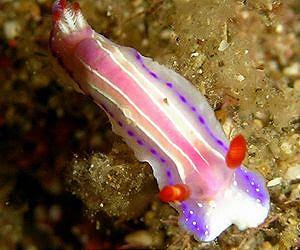
Shape up quickly - applies to fish too
Gothenburg, Sweden (SPX) Oct 01, 2014 -
Fish can live in almost any aquatic environment on Earth, but when the climate changes and temperatures go up many species are pushed to the limit. The amount of time needed to adjust to new conditions could prove critical for how different species cope in the future, reveals a new study from researchers at the University of Gothenburg, published in the scientific journal Proceedings of the Roya ...
more

 New mechanism reveals how molecules become trapped in ice
Washington DC (SPX) Oct 01, 2014 -
Ice is ubiquitous in nature-found within terrestrial and astrophysical environments alike-and contains many atoms and molecules trapped inside it. For example, ice beneath the world's oceans hosts a vast reservoir of greenhouse gases, which if released would have a profound effect on climate change.
On the earth's surface, seasonal ice and permafrost-covered regions represent a vast reserv ...
more
New mechanism reveals how molecules become trapped in ice
Washington DC (SPX) Oct 01, 2014 -
Ice is ubiquitous in nature-found within terrestrial and astrophysical environments alike-and contains many atoms and molecules trapped inside it. For example, ice beneath the world's oceans hosts a vast reservoir of greenhouse gases, which if released would have a profound effect on climate change.
On the earth's surface, seasonal ice and permafrost-covered regions represent a vast reserv ...
more

 Nitrogen fingerprint in biomolecules could be from early sun
San Diego CA (SPX) Oct 01, 2014 -
Chemical fingerprints of the element nitrogen vary by extremes in materials from the molecules of life to the solar wind to interstellar dust. Ideas for how this great variety came about have included alien molecules shuttled in by icy comets from beyond our solar system and complex chemical scenarios.
New experiments using a powerful source of ultraviolet light have shown that no extra-so ...
more
Nitrogen fingerprint in biomolecules could be from early sun
San Diego CA (SPX) Oct 01, 2014 -
Chemical fingerprints of the element nitrogen vary by extremes in materials from the molecules of life to the solar wind to interstellar dust. Ideas for how this great variety came about have included alien molecules shuttled in by icy comets from beyond our solar system and complex chemical scenarios.
New experiments using a powerful source of ultraviolet light have shown that no extra-so ...
more

Instant speciation, biodiversity, and the root of our existence
Washington DC (SPX) Oct 01, 2014 -
What do seedless watermelon, salmon, and strawberries all have in common? Unlike most eukaryotic multicellular organisms that have two sets of chromosomes and are diploid, these organisms are all polyploid, meaning they have three or more sets of chromosomes-seedless watermelon and salmon have 3 and 4 sets of chromosomes, respectively, and strawberries have 10! While this might seem surprising, ...
more

